
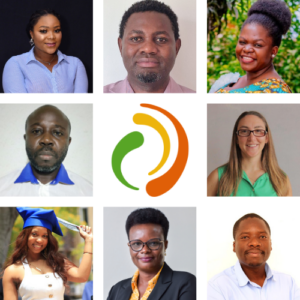
 Congratulations to our 2026 Appreciative Inquiry-Based D&I Course cohort for completing our five-week course — Innovative D&I Approaches: Appreciative Inquiry and Discrete Choice Experiments! This year’s course focused on designing and applying Discrete Choice Experiments to sustain evidence-based HIV programs for adolescents and young adults in resource-constrained settings. After an expert review process, eight participants were chosen from more than 75 applicants to represent each PATC³H-IN clinical research center. Over five weeks, participants learned about the principles of appreciative inquiry and implemntation science and were trained on how to administer, apply, and analyze discrete choice experiments.
Over the remainder of their year with INSPIRE, course participants will serve as liaisons for a shared discrete choice experiment at their respective PATC³H-IN clinical research centers. They will go through the ethical review process, collect and analyze data, and contribute to a manuscript on the experiment.
We were more used to quantitative studies before now. Then we began to understand appreciate that mixed-method studies were better and richer than simple quantitative studies. It was a profound excitement for me to discover in this course something called “DCE” (Discrete Choice Experiments)… Taking this course will take you to another level in research.
Meet the cohort
 Sonnen Atinge | iCARE Plus
 Sonnen Atinge | iCARE Plus
Sonnen Atinge is a Nigerian public health physician, epidemiologist, and researcher dedicated to improving health outcomes for people living with HIV through clinical care and research across prevention, treatment, and support services. He holds an MBBS from the University of Maiduguri, a Master of Public Health, and a Master of Science in Public Health–Epidemiology from the University of Lagos. He is also a Fellow of the National Postgraduate Medical College of Nigeria in Public Health and Community Medicine. In 2023, he completed, with distinction, the NIH-funded Emory-Nigeria HIV Research Training Program at Emory University, where he received advanced training in biostatistics, research ethics, and data management and analysis.
Sonnen Atinge is a lecturer in the Department of Public Health and Community Medicine at the Federal University Wukari, Taraba State. He also serves as a co-investigator on the iCARE Nigeria Plus effectiveness–implementation hybrid study, a scale-up program evaluating youth-focused HIV interventions among young men who have sex with men and young transgender women. In this role, he oversees outreach activities, HIV testing services, and local surveillance data collection.
Earlier in his career, Sonnen Atinge led a district hospital in a hard-to-reach border region and helped establish a comprehensive HIV/AIDS center with support from FHI 360, expanding access to care for previously underserved communities. He has also worked as an ART clinician at the tertiary level and has authored 26 peer-reviewed publications. He is committed to advancing HIV research and developing as an independent researcher and mentor to emerging scholars in Nigeria.
Doreen Kemigisha | MU-JHU
 Doreen Kemigisha | MU-JHU
Doreen Kemigisha is a social worker and public health professional with over 15 years of experience in HIV prevention among adolescents, women at increased risk, and their partners in sub-Saharan Africa, particularly Uganda. She holds a Bachelor of Arts and a Master of Public Health with a focus on Health Promotion and has completed additional training at the University of Washington in epidemiology for global health, global mental health, project management in global health, and implementation science.
Her career reflects a strong commitment to community engagement and behavioral research. She has progressed from field recruitment and health visiting to senior leadership roles in community engagement and qualitative research coordination. As a Community Engagement Lead, she has supervised teams of community educators and implemented evidence-based strategies for multiple research protocols, including stakeholder and Community Advisory Board engagement, community mapping, mobilization, and tailored recruitment and retention approaches. Her work has strengthened partnerships between communities and research teams while promoting ethical participation in studies.
Grounded in social work and public health, her approach emphasizes empathy, cultural sensitivity, and community empowerment. She is dedicated to translating community voices into research and policy that advance equitable access to HIV prevention and improve health outcomes in Uganda and beyond.
Aishat Adedoyin Koledowo | S-ITEST
 Aishat Adedoyin Koledowo | S-ITEST
Aishat Adedoyin Koledowo is a public health professional and advocate for youth health empowerment with interests spanning infectious disease prevention, epidemiology, reproductive health, and behavior change. Her work focuses on improving health outcomes for diverse populations, particularly adolescents and young adults, through evidence-based and youth-centered approaches.
She holds a Bachelor of Science in Public Health from Lead City University and is currently pursuing a Master of Public Health. Koledowo serves as a Research Officer at the Lagos State Health Management Agency, where she supports the design and implementation of evidence-based interventions that strengthen health systems and improve service delivery across Lagos State. Her role includes contributing to research and data-informed strategies that enhance program effectiveness and population health outcomes.
In addition to her professional work, she is a Youth Ambassador with 4 Youth By Youth, where she leads HIV/AIDS awareness initiatives and promotes HIV self-testing and healthy behaviors among young people. Through targeted outreach and youth-focused advocacy, she has contributed to increased HIV testing uptake and greater awareness of preventive health practices among adolescents and youth.
Yolanda Mayman | ATTUNE
 Yolanda Mayman | ATTUNE
Yolanda Mayman is a final-year PhD candidate at the School of Public Health, University of the Western Cape, whose work focuses on adolescent health, HIV, and the systemic impacts of the COVID-19 pandemic in South Africa. With a background in research psychology, she brings an interdisciplinary lens to public health research. Her doctoral work examined how the COVID-19 pandemic and vaccine rollout influenced the mental well-being, treatment adherence, and healthcare engagement of adolescents living with HIV (ALHIV) in Cape Town. Using a multi-phase mixed-methods design, her research highlights the lived experiences, vulnerabilities, and resilience of ALHIV within complex health systems.
Yolanda Mayman has strong expertise in qualitative methodologies and has supported research capacity-building workshops and mentorship initiatives that strengthen qualitative inquiry and youth-focused HIV research. She has published five articles from her doctoral work, with another under review, and has co-authored additional papers on adolescent mental health, HIV care, and community-based participatory research. She has presented her work at major academic forums, including PHASA, CREATE, the NRF Emerging Researchers Symposium, and the SAMRC Early Scientist Convention.
Her planned postdoctoral research will explore the feasibility, acceptability, and user preferences of long-acting injectable antiretroviral therapy among adolescents in the Western Cape. Passionate about strengthening health systems for young people in Africa, Yolanda Mayman is committed to translating research into practice, mentoring emerging scholars, and advancing youth-centred, contextually grounded approaches to improving health outcomes.
Agatha Mnyippembe | MWOTAJI
 Agatha Mnyippembe | MWOTAJI
Agatha Mnyippembe is a junior health researcher specializing in HIV prevention and youth sexual and reproductive health in Tanzania. She combines academic training in health monitoring and evaluation with hands-on experience in field-based project coordination to generate evidence that informs practice and policy.
Agatha Mnyippembe’s expertise includes mixed-methods research design, program monitoring, and qualitative and quantitative data management and analysis. She has experience designing and evaluating strategies to improve service uptake in resource-constrained settings, with a particular focus on youth-friendly services and HIV prevention options for young women. She also brings strong project management skills, including study operations management, supervision of field implementation, stakeholder engagement, and capacity building for local research teams.
She is currently involved in two initiatives aimed at improving healthcare access for young women. In the Malkia Klabu Program in Zanzibar, she supports a feasibility and acceptability study of a pharmacy-based model delivering girl-friendly HIV prevention and reproductive health services, coordinating data collection and contributing to analysis. She also coordinates the MWOTAJI Project (“Making Women’s Options for HIV Prevention in Tanzania Accessible”), which integrates implementation science capacity building with program delivery, research planning, scientific writing, and translation of findings into program recommendations.

Mwamba Mwenge | ZAIMARA
Mwamba Mwenge is a Zambian public health professional and early-career social and behavioral researcher with over a decade of experience implementing mental health randomized controlled trials, adolescent health studies, and evidence-based interventions in Zambia. As an implementation scientist, he has strong expertise in research design, data systems, program monitoring, and community-based mental health interventions. He holds a Master of Science in Public Health from the University of South Wales, an MBA in Management Strategy, a Bachelor of Arts in Public Administration from the University of Zambia, and a Diploma in Computing. His multidisciplinary training supports his ability to integrate public health research, program management, and digital data systems in low-resource settings.
His current work on the ZAIMARA study includes adapting adolescent health promotion materials, collaborating with adolescent community advisory boards, and designing participant monitoring frameworks, as well as building data management capacity among research staff. He previously served as a Data Manager for an NIH-funded R01 study, overseeing monitoring and evaluation tools, quality assurance, ethical compliance, and data systems. He also worked as Research Manager for the EQUIP Pilot Study, contributing to cultural adaptation of counselor competency tools and fidelity assessments.
Mwenge has progressed through roles ranging from data entry to implementation science, giving him broad insight into the research lifecycle. In 2022, he received an early-career grant from RSTMH and NIHR to study caregivers’ experiences during COVID-19. He has authored multiple peer-reviewed publications and is committed to strengthening mental health systems and advancing implementation science in Zambia and sub-Saharan Africa.
Gift Ndalumbira | RISE
 Gift Ndalumbira | RISE
Gift Ndalumbira is a public health professional with over eight years of experience implementing HIV/AIDS prevention, care, and treatment programs across diverse settings. His work focuses on strengthening health systems through quality improvement initiatives and developing sustainable solutions to improve outcomes for key and vulnerable populations affected by HIV. With both clinical and public health experience, he brings a systems-level perspective to improving service delivery at individual and population levels.
He is an emerging researcher with experience in public health research coordination and currently serves in a formal Research Coordinator role focused on evidence-based HIV interventions for sexual and gender minority youth. His interests include applying innovative research approaches to address health disparities, generate high-quality data, and inform inclusive prevention and treatment strategies in resource-limited settings.
Ndalumbira holds a Master of Public Health with a concentration in Epidemiology, which has provided strong training in research methods, data analysis, and evidence-based decision-making. He also holds a Bachelor of Science in Public Health and a Diploma in Nursing and Midwifery. This multidisciplinary background enables him to work effectively across both preventive and clinical health services. He is committed to advancing equitable, data-driven HIV programming and continuing to build his research career to support inclusive, high-impact public health interventions.

Katherine Simon | VS4A
Katherine Simon is a pediatrician with 14 years of clinical and public health experience serving underserved communities in the United States and internationally. She has been based in Malawi since 2012 with the Baylor International Pediatric AIDS Initiative (now Texas Children’s Global Health Corps), where she works as a pediatric consultant. For 11 years, she served as Medical Director of Tingathe, a PEPFAR-funded program supporting the Malawi Ministry of Health in advancing progress toward UNAIDS HIV targets.
Simon currently serves as a Senior Technical Advisor overseeing HIV care and treatment for the CORE (Client Oriented Response to achieve HIV Epidemic Control) project, a five-year, $80 million PEPFAR-funded initiative supporting 96 health facilities across six districts in Malawi. In this role, she co-leads efforts to design and implement high-quality HIV and tuberculosis services.
While primarily focused on programmatic and technical leadership, Katherine Simon has built practical research experience through operational research and program evaluation. She has collaborated with research-trained colleagues to apply quality improvement approaches—design, implement, evaluate, and redesign—to strengthen services, contributing to interventions that improved care quality and resulted in peer-reviewed publications. Her work is driven by a commitment to improving the quality of life for children and families.